


Lift...WHY
 Feb 17, 2009 | 08:21 PM
#102

You DO realize I'm an engineer and AxleIke is a scientist, right? That we have college degrees in this shtuff?
The box on an angle diagram is being used to show the normal force varies with angle - it has nothing to do with the contact area.
It's VERY easy to inject a competition tread compound into a mold you already have ... very expensive to make a mold just for the competition group.
Please read it again. Pay particular note to the chart showing the coefficients of friction for various materials and the lack of mention of area. Also the two sentences "However, the coefficient of friction is not a function of mass or volume; it depends only on the material. For instance, a large aluminum block has the same coefficient of friction as a small aluminum block."
Whether a tall/skinny tire works in CO and doesn't work in WA is not the point here - that may very well be the case. The point is that CONTACT AREA has NO effect on the fricional force, and since a skinny tire and a wide tire generate the same friction force, but the skinny tire generates more unit pressure and fits better for a given amount of lift, that GENERALLY the tall/skinny tire is a better choice for MOST of us.
and back on topic - since a 33x10.50 will fit with no lift, have the same ground clearance under the axles and less stress on the various components, I don't see any reason why you should lift a preTacoma IFS rig.
The box on an angle diagram is being used to show the normal force varies with angle - it has nothing to do with the contact area.
It's VERY easy to inject a competition tread compound into a mold you already have ... very expensive to make a mold just for the competition group.
Please read it again. Pay particular note to the chart showing the coefficients of friction for various materials and the lack of mention of area. Also the two sentences "However, the coefficient of friction is not a function of mass or volume; it depends only on the material. For instance, a large aluminum block has the same coefficient of friction as a small aluminum block."
Whether a tall/skinny tire works in CO and doesn't work in WA is not the point here - that may very well be the case. The point is that CONTACT AREA has NO effect on the fricional force, and since a skinny tire and a wide tire generate the same friction force, but the skinny tire generates more unit pressure and fits better for a given amount of lift, that GENERALLY the tall/skinny tire is a better choice for MOST of us.
and back on topic - since a 33x10.50 will fit with no lift, have the same ground clearance under the axles and less stress on the various components, I don't see any reason why you should lift a preTacoma IFS rig.
Please when you try to brow beat other with you college degrees please spell the simple words correct. Hell I'm dyslexic and caught that.
Feb 17, 2009 | 08:24 PM
#103

Contributing Member
Joined: Dec 2005
Posts: 2,124
Likes: 0
From: Los Osos, CA (we can't agree on crap!)
good way to gain more suspension travel which can lead to:
possible improved on road ride (my 4runner rode much better after the bj spacer/cruiser coil lift and that is from my wife who was DDing it at the time and was annoyed that I had the 4runner down for two days to do the lift) I can't comment on other lift combos, so that's why I said "possible"
more stability on the trail when flexing (keeping more tires in contact with earth longer)
improved ride on high speed runs, fire roads, etc...
meh..... the tire talk needs to go to another thread. It's a good debate but off topic here because on 2nd gens you can pretty much fit the 33x10.5 and 33x12.5 (with correct backspacing) with no lift, so it doesn't matter in the "why lift" thread
possible improved on road ride (my 4runner rode much better after the bj spacer/cruiser coil lift and that is from my wife who was DDing it at the time and was annoyed that I had the 4runner down for two days to do the lift) I can't comment on other lift combos, so that's why I said "possible"
more stability on the trail when flexing (keeping more tires in contact with earth longer)
improved ride on high speed runs, fire roads, etc...
meh..... the tire talk needs to go to another thread. It's a good debate but off topic here because on 2nd gens you can pretty much fit the 33x10.5 and 33x12.5 (with correct backspacing) with no lift, so it doesn't matter in the "why lift" thread
Last edited by slosurfer; Feb 17, 2009 at 08:28 PM.
Feb 17, 2009 | 08:32 PM
#104
Contributing Member
Joined: Dec 2003
Posts: 2,893
Likes: 2
From: Fort Worth, TX
The fact is you've been arguing for pages about the effect of surface area on friction, only to neglect two of the MOST important facts considering a tire's traction off-road:
1) Sure, freshman physics states that friction to a first order approximation is merely a function of surface area and frictional coefficient, but unfortunately for everyone friction is a fickle mistress. In reality application to vehicles is a bit (or a lot) more complex. For example, it is known for cars that a tire's apparent frictional coefficient actually decreases as the normal force applied to it increases. This is for a couple of reasons, but the most prominent are tread deformation and rubber's performance under shear.
Off-road tires are even more likely to suffer tread deformation, because they have deeper tread and taller lugs to start with. Wider tires generally have more tread available when compared to a tire of the same tread pattern, and as such deforms less under stress. Now I'm not saying a 33x9.50" tire does not perform as well as a 33x12.50" in all situations, but a 33x9.50" is most definitely more likely to suffer from tread deformation and lose traction faster. Ask yourself: Why is it that a Corvette Z06 has 335mm (13.1") wide tires in the back? If you get the same friction from narrow and wide tires, the Corvette should be able to run a 225mm wide tire and get the same traction; of course this isn't the case.
Which brings me to the next problem-
Whether a tall/skinny tire works in CO and doesn't work in WA is not the point here - that may very well be the case. The point is that CONTACT AREA has NO effect on the fricional force, and since a skinny tire and a wide tire generate the same friction force, but the skinny tire generates more unit pressure and fits better for a given amount of lift, that GENERALLY the tall/skinny tire is a better choice for MOST of us.
But when we've left the perfect world of linear friction, what can we do about a tire on a dirt road where the tire's tread deforms under shear force and the dirt underneath it is only able to take so much shear force per unit area before shooting out from under the tire? Obviously, a single frictional coefficient will do a very poor job of describing the forces available at the tires in this case.
Linear friction just isn't applicable to off-road situations. You've done a wonderful job describing exactly how it works, but it's all for naught since it has little relevance to off-road tire performance.
... and why limit to pre-Tacoma rigs? They're both IFS, and both limited in travel by their bump-stops and CV capabilities, so why is a Tacoma allowed to be lifted but a pre-Taco isn't? Coilovers?
Feb 17, 2009 | 09:25 PM
#105

Contributing Member
Joined: Apr 2004
Posts: 5,464
Likes: 6
From: Arvada, Colorado
I had basically ducked out of this thread because it's going nowhere fast; but seriously, is throwing around your college degree really going to win this argument? I'm an engineer too, but I don't agree with much of your "no lift" philosophy. So what?
The fact is you've been arguing for pages about the effect of surface area on friction, only to neglect two of the MOST important facts considering a tire's traction off-road:
1) Sure, freshman physics states that friction to a first order approximation is merely a function of surface area and frictional coefficient, but unfortunately for everyone friction is a fickle mistress. In reality application to vehicles is a bit (or a lot) more complex. For example, it is known for cars that a tire's apparent frictional coefficient actually decreases as the normal force applied to it increases. This is for a couple of reasons, but the most prominent are tread deformation and rubber's performance under shear.
Off-road tires are even more likely to suffer tread deformation, because they have deeper tread and taller lugs to start with. Wider tires generally have more tread available when compared to a tire of the same tread pattern, and as such deforms less under stress. Now I'm not saying a 33x9.50" tire does not perform as well as a 33x12.50" in all situations, but a 33x9.50" is most definitely more likely to suffer from tread deformation and lose traction faster. Ask yourself: Why is it that a Corvette Z06 has 335mm (13.1") wide tires in the back? If you get the same friction from narrow and wide tires, the Corvette should be able to run a 225mm wide tire and get the same traction; of course this isn't the case.
Which brings me to the next problem-
2) Sure, two blocks of aluminum have a pretty simple well understood set of equations that define the frictional force between them. They are stiff blocks that are resistant to shear deformation and don't take into account interstitial material.
But when we've left the perfect world of linear friction, what can we do about a tire on a dirt road where the tire's tread deforms under shear force and the dirt underneath it is only able to take so much shear force per unit area before shooting out from under the tire? Obviously, a single frictional coefficient will do a very poor job of describing the forces available at the tires in this case.
Linear friction just isn't applicable to off-road situations. You've done a wonderful job describing exactly how it works, but it's all for naught since it has little relevance to off-road tire performance.
Perhaps you have the same clearance under the rear axle, but lifting a mere 2-3" can make a measurable difference in not only body clearance, but front cross-member clearance, as well as approach, departure, and transverse angles. Perhaps you don't see any reason to lift a pre-Tacoma IFS rig, but I can think of lots of situations where a (small) lift can be beneficial. Your opinion is still an opinion (as is mine), no matter how convinced you are that it is the best way to go.
... and why limit to pre-Tacoma rigs? They're both IFS, and both limited in travel by their bump-stops and CV capabilities, so why is a Tacoma allowed to be lifted but a pre-Taco isn't? Coilovers?
The fact is you've been arguing for pages about the effect of surface area on friction, only to neglect two of the MOST important facts considering a tire's traction off-road:
1) Sure, freshman physics states that friction to a first order approximation is merely a function of surface area and frictional coefficient, but unfortunately for everyone friction is a fickle mistress. In reality application to vehicles is a bit (or a lot) more complex. For example, it is known for cars that a tire's apparent frictional coefficient actually decreases as the normal force applied to it increases. This is for a couple of reasons, but the most prominent are tread deformation and rubber's performance under shear.
Off-road tires are even more likely to suffer tread deformation, because they have deeper tread and taller lugs to start with. Wider tires generally have more tread available when compared to a tire of the same tread pattern, and as such deforms less under stress. Now I'm not saying a 33x9.50" tire does not perform as well as a 33x12.50" in all situations, but a 33x9.50" is most definitely more likely to suffer from tread deformation and lose traction faster. Ask yourself: Why is it that a Corvette Z06 has 335mm (13.1") wide tires in the back? If you get the same friction from narrow and wide tires, the Corvette should be able to run a 225mm wide tire and get the same traction; of course this isn't the case.
Which brings me to the next problem-
2) Sure, two blocks of aluminum have a pretty simple well understood set of equations that define the frictional force between them. They are stiff blocks that are resistant to shear deformation and don't take into account interstitial material.
But when we've left the perfect world of linear friction, what can we do about a tire on a dirt road where the tire's tread deforms under shear force and the dirt underneath it is only able to take so much shear force per unit area before shooting out from under the tire? Obviously, a single frictional coefficient will do a very poor job of describing the forces available at the tires in this case.
Linear friction just isn't applicable to off-road situations. You've done a wonderful job describing exactly how it works, but it's all for naught since it has little relevance to off-road tire performance.
Perhaps you have the same clearance under the rear axle, but lifting a mere 2-3" can make a measurable difference in not only body clearance, but front cross-member clearance, as well as approach, departure, and transverse angles. Perhaps you don't see any reason to lift a pre-Tacoma IFS rig, but I can think of lots of situations where a (small) lift can be beneficial. Your opinion is still an opinion (as is mine), no matter how convinced you are that it is the best way to go.
... and why limit to pre-Tacoma rigs? They're both IFS, and both limited in travel by their bump-stops and CV capabilities, so why is a Tacoma allowed to be lifted but a pre-Taco isn't? Coilovers?
As TC pointed out, I am NOT an engineer. I have a background in "theory". Thus, I freely admit that my assumptions about reality can be completely wrong. However, its not freshman physics. Senior physics makes a ton of the same assumptions about the COF.
but...then again, you know what they say about assuming, right? I've made more mistakes assuming stuff than I care to admit.

This post, however, is VERY interesting. Thus, I hope to learn from it as it challenges my understanding, which I'm actually a HUGE fan of.
I'm confused by rubber actually reducing it's coefficient by increasing the normal force or weight??
Is this because it is a non rigid body? I guess I just can't wrap my head around that. My experience tells me that if I push on something, its harder to slide.
Also, when talking about tread deformation, that too is counter intuitive to my own understanding. Generally, we air down our tires to increase the deformation, and thus gain traction. I agree that a narrow tire will deform more, but I was under the impression that was a good thing. Not saying you are wrong, but I'd like to hear more about it.
The corvette point goes back to my original point, and, if rubber looses frictional force with increased weight, then my point is wrong. However, I always said that it was certainly likely that a wider tire would get better traction because of its increased contact.
I still maintain that a narrower tire is better simply from a practicality stand point. While you are correct, a lift can increase clearance under the frame and bumpers, your suspension will still compress to the same spot, and you will still rub a tire. A narrower tire has a smaller scrub radius, which means it will rub less for the same diameter when fully stuffed. In a first and second gen 4runner, this means that a 33x10.50 will stuff without issue with minor deformation of the pinch weld. A 33x12.50 will not. For some, this isn't an issue. It was for me.
I have also noticed that 2-3" on the street, sitting still, does not always correspond to clearance on the trail, as obstacles vary so much, its impossible to make a definitive call. Some it will help you on, some, it won't make a difference, and some it will hurt you on.
Lift also increases the COG.
I guess I'm mostly fascinated with the physics of the tires. That, to me, is cool tech.
As for the original point, run whatever lift and tire you want. I can talk till I'm blue in the face about how lifts are the least bang for the buck offroad. If we are talking early IFS, and small (33" or below tire diameter), I'll take my lockers, gears, and skinny tires over a lift any day.
To the rest of the folks, run whatever works for you.
Feb 17, 2009 | 10:19 PM
#106
Contributing Member
Joined: Dec 2005
Posts: 2,124
Likes: 0
From: Los Osos, CA (we can't agree on crap!)
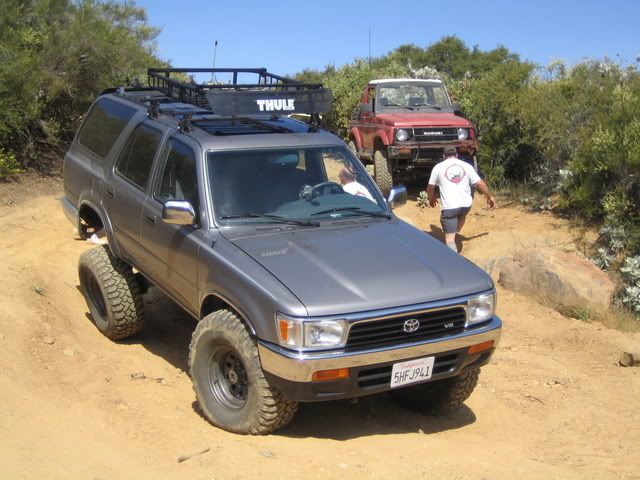
How the lower arm was in relation to the low pro bumpstop (I can get the arms to touch the low pro bumpstops)

As for the original point, run whatever lift and tire you want. I can talk till I'm blue in the face about how lifts are the least bang for the buck offroad. If we are talking early IFS, and small (33" or below tire diameter), I'll take my lockers, gears, and skinny tires over a lift any day.
For example, I started wheeling my 4runner stock w/ 31's and reached where I needed more for the trails. It was about time for new shocks, so I researched lifts since I didn't want to buy new shocks and then later change my mind and lift and have to get more new shocks. I could barely afford it but went with shocks and a lift that gave me an improved ride and more suspension travel. This worked well and then I went to 33's which also helped on the trail. During this time I wheeled with both 31's and 33's and being open/open the biggest help was not tires but the added flex (especially the rear) which kept tires on the ground. Now I definately reached a point where what I wanted to do needed lockers and regear for the bigger tires. It took a long time to save up the money and parts to do that, I wheeled the whole time and did trails that called for lockers and was able to make it through due to bigger tires and flexible suspension. Finally now I'm double locked and regeared. It will be a long time to never till I get low TC gears since I have an auto.
There is no way that I will argue that a lift/flex trumps lockers and gears, that's a no brainer, but it did allow me to continue wheeling hard trails whereas I would have been stuck waiting, while trying to provide for my family and save up for tires/lockers/gears. So for someone in my situation, it may be the best "bang for the buck".
Feb 18, 2009 | 05:49 AM
#107
Contributing Member
Joined: Dec 2003
Posts: 2,893
Likes: 2
From: Fort Worth, TX
Also, when talking about tread deformation, that too is counter intuitive to my own understanding. Generally, we air down our tires to increase the deformation, and thus gain traction. I agree that a narrow tire will deform more, but I was under the impression that was a good thing. Not saying you are wrong, but I'd like to hear more about it.
Longitudinally, a narrow tire has less tread lugs (compared to a wider tire of the same tread pattern), so each lug is subject to more force as a car is grinding itself forward and the lugs will therefore deform more. In environments with sufficient traction for the task at hand, it's never noticed; but the effect is there nonetheless.
When I went to 33x12.50 Interco TrXuS M/T's, they definitely rubbed, but their traction off-road was incredible in everything except sand. In sand they dug too easily and were too heavy for the tired 3.slow to turn fast.
For my 3rd gen now, I think a 285x75r16 (or 285x70r17 like I'm running) is a great size because it's still easily cleared, and has a good width-to-diameter ratio like the 33x10.50 on the 2nd gen. I'm not personally a huge fan of the 255x85r16's, but those are essentially a 33x10.50 in size, where as a 285x75r16 is more like a 33x11.50.
Feb 18, 2009 | 06:03 AM
#108
Contributing Member
Joined: Nov 2007
Posts: 776
Likes: 0
From: Indiana
Well if we seperate friction from traction in trire than it seems this is a mute point. And simply going in a circle of I'm right your wrong. http://www.merriam-webster.com/dictionary/traction definiton #3a fits so dudes your soo right, in a paralell deminsion or something. So I think you equation would apply to railroad were the dimensional contact is constant and the surface area is as well on the contact of two constant surfaces, like a rail wheel on a steel rail.
I know my experereinces from rock climbing, mountain biking, motorcycles, and 4 wheeling. You can direct as much weight as you can muster on a small contact area and afterward sit on your butt wonder what went wrong. The same amount of force over a wider contact patch will leave you on the rock face, in the saddle and looking for the next obstacle. Though not true in every surface or terrain but for rock yeah.
If a wider footprint is less value than a single point of contact with great amount of force pushing it down than why on earth do we air down on trails?
Sai I really don't see where either were your coming from.
I know my experereinces from rock climbing, mountain biking, motorcycles, and 4 wheeling. You can direct as much weight as you can muster on a small contact area and afterward sit on your butt wonder what went wrong. The same amount of force over a wider contact patch will leave you on the rock face, in the saddle and looking for the next obstacle. Though not true in every surface or terrain but for rock yeah.
If a wider footprint is less value than a single point of contact with great amount of force pushing it down than why on earth do we air down on trails?
Sai I really don't see where either were your coming from.
Feb 18, 2009 | 06:40 AM
#109
Contributing Member
Joined: Apr 2004
Posts: 5,464
Likes: 6
From: Arvada, Colorado
It was hard for me to comprehend at first as well, but books that cover theory of vehicle performance have graphs that describe a tire's drop in COF as a function of normal force, both longitudinally and laterally. COF tends to drop off somewhat faster in the lateral directions due to sidewall rollover causing the tread to deform in a "wave" while longitudinal deformation is more complicated but does occur.
Well think about it, airing down = more traction, but how can that be true if friction is independent of surface area? I think narrow tires are generally more likely to suffer from sidewall rollover, which can decrease a tire's lateral grip.
Longitudinally, a narrow tire has less tread lugs (compared to a wider tire of the same tread pattern), so each lug is subject to more force as a car is grinding itself forward and the lugs will therefore deform more. In environments with sufficient traction for the task at hand, it's never noticed; but the effect is there nonetheless.
Yup, for sports cars sidewall rollover is a killer of lateral grip, so wide low-pro tires resist lateral drop off, and longitudinal drop off is reduced due to the wider contact patch of the tire. I would assume that a combination of lateral and longitudinal forces (like accelerating through the exit of a curve) also have a say in the matter.
I would say it depends on how narrow you go. From personal experience I would say a 33x10.50 is the BEST tire size for 1st and 2nd gen 4Runner because it is easily cleared and has a good width-to-diameter ratio. My favorite tires hands down on my 2nd gen 4Runner were my 33x10.50 BFG A/T's. But, that being said, a 33x9.50 is too narrow IMO.
When I went to 33x12.50 Interco TrXuS M/T's, they definitely rubbed, but their traction off-road was incredible in everything except sand. In sand they dug too easily and were too heavy for the tired 3.slow to turn fast.
For my 3rd gen now, I think a 285x75r16 (or 285x70r17 like I'm running) is a great size because it's still easily cleared, and has a good width-to-diameter ratio like the 33x10.50 on the 2nd gen. I'm not personally a huge fan of the 255x85r16's, but those are essentially a 33x10.50 in size, where as a 285x75r16 is more like a 33x11.50.
Well think about it, airing down = more traction, but how can that be true if friction is independent of surface area? I think narrow tires are generally more likely to suffer from sidewall rollover, which can decrease a tire's lateral grip.
Longitudinally, a narrow tire has less tread lugs (compared to a wider tire of the same tread pattern), so each lug is subject to more force as a car is grinding itself forward and the lugs will therefore deform more. In environments with sufficient traction for the task at hand, it's never noticed; but the effect is there nonetheless.
Yup, for sports cars sidewall rollover is a killer of lateral grip, so wide low-pro tires resist lateral drop off, and longitudinal drop off is reduced due to the wider contact patch of the tire. I would assume that a combination of lateral and longitudinal forces (like accelerating through the exit of a curve) also have a say in the matter.
I would say it depends on how narrow you go. From personal experience I would say a 33x10.50 is the BEST tire size for 1st and 2nd gen 4Runner because it is easily cleared and has a good width-to-diameter ratio. My favorite tires hands down on my 2nd gen 4Runner were my 33x10.50 BFG A/T's. But, that being said, a 33x9.50 is too narrow IMO.
When I went to 33x12.50 Interco TrXuS M/T's, they definitely rubbed, but their traction off-road was incredible in everything except sand. In sand they dug too easily and were too heavy for the tired 3.slow to turn fast.
For my 3rd gen now, I think a 285x75r16 (or 285x70r17 like I'm running) is a great size because it's still easily cleared, and has a good width-to-diameter ratio like the 33x10.50 on the 2nd gen. I'm not personally a huge fan of the 255x85r16's, but those are essentially a 33x10.50 in size, where as a 285x75r16 is more like a 33x11.50.
FWIW, I also think that a 9.50 is too narrow, but that is just from my experiences on the trail with both my truck and TC's. I find that my tires blow beads more often, as well as give me too narrow a profile for the snow.
The info about COF of tires is quite interesting. I'll be looking into that more, just for curiosity's sake.
Feb 18, 2009 | 07:03 AM
#110
Contributing Member
Joined: Dec 2003
Posts: 2,893
Likes: 2
From: Fort Worth, TX
Here is an interesting link describing a tire's decrease in COF with load increase:
http://buildafastercar.com/node/10
I also found this site which brings up some interesting points for both on and off-road tire performance (for RC cars):
http://home.scarlet.be/~be067749/58/c1/index.htm
http://buildafastercar.com/node/10
I also found this site which brings up some interesting points for both on and off-road tire performance (for RC cars):
http://home.scarlet.be/~be067749/58/c1/index.htm
Last edited by mastacox; Feb 18, 2009 at 07:05 AM.
Feb 18, 2009 | 07:07 AM
#111

Contributing Member
Joined: Nov 2005
Posts: 8,875
Likes: 3
From: Longmont, CO
I still stand that the COF for the same tread pattern, same rubber compound, same inflation pressure, same weight rig is the same. Of course, those conditions are rarely the case in the real world. I will grant you that there are a number of other factors in comparing a narrow tire to a wide tire in the real world that can make a difference.
Obviously, lowering air pressure will increase your COF, but not so much by increasing the area as by allowing the tread to wrap around obstacles, changing the direction of the normal force.
But anyway - back on topic:
There are 2 places above where people claim an IFS lift provides increased travel. This is absolutely not true. Replacing the bumpstops, or changing the geometry (balljoint spacer, long travel arms) will increase the IFS travel, but simply lifting it will not as the bumpstops remain in the asme place.
As for why not Tacomas - well, their suspension is different. They do not have droop bumpstops, so it IS possible to increase the travel with them. Also, you can not fit 33's on them without a lift.
One other thing to consider - it does little to no good to have a ton of travel with the rear solid axle and still have the limited IFS travel. What makes a vehicle wheel well is balance. Compression travel in particular helps as once you hit the bumpstop, that corner of the truck is going up - no way around it. Droop travel makes for good pictures, but is next to worthless as the force on the wheel decreases as the suspension droops (back to that "normal force" argument again). While there is some leverage from one side to the other with a solid axle, that stops also when you hit the compression bumpstop.
Obviously, lowering air pressure will increase your COF, but not so much by increasing the area as by allowing the tread to wrap around obstacles, changing the direction of the normal force.
But anyway - back on topic:
There are 2 places above where people claim an IFS lift provides increased travel. This is absolutely not true. Replacing the bumpstops, or changing the geometry (balljoint spacer, long travel arms) will increase the IFS travel, but simply lifting it will not as the bumpstops remain in the asme place.
As for why not Tacomas - well, their suspension is different. They do not have droop bumpstops, so it IS possible to increase the travel with them. Also, you can not fit 33's on them without a lift.
One other thing to consider - it does little to no good to have a ton of travel with the rear solid axle and still have the limited IFS travel. What makes a vehicle wheel well is balance. Compression travel in particular helps as once you hit the bumpstop, that corner of the truck is going up - no way around it. Droop travel makes for good pictures, but is next to worthless as the force on the wheel decreases as the suspension droops (back to that "normal force" argument again). While there is some leverage from one side to the other with a solid axle, that stops also when you hit the compression bumpstop.
Feb 18, 2009 | 07:36 AM
#112
Contributing Member
Joined: Dec 2005
Posts: 2,124
Likes: 0
From: Los Osos, CA (we can't agree on crap!)
But anyway - back on topic:
There are 2 places above where people claim an IFS lift provides increased travel. This is absolutely not true. Replacing the bumpstops, or changing the geometry (balljoint spacer, long travel arms) will increase the IFS travel, but simply lifting it will not as the bumpstops remain in the asme place.
Compression travel in particular helps as once you hit the bumpstop, that corner of the truck is going up - no way around it. Droop travel makes for good pictures, but is next to worthless as the force on the wheel decreases as the suspension droops (back to that "normal force" argument again). While there is some leverage from one side to the other with a solid axle, that stops also when you hit the compression bumpstop.
ANd your comment about the solid axle contacting the compression bumpstop is why I believe a decent rear lift can help as well, seeing as how you now have more travel before hitting your bumpstop.
The tire stuff is really cool and could almost be "sticky" worthy.
Feb 18, 2009 | 07:37 AM
#113
Contributing Member
Joined: Dec 2003
Posts: 2,893
Likes: 2
From: Fort Worth, TX
I think this mainly has to do with the fact that dirt has a limited amount of shear force per unit area it can take before it deforms and the tire spins. If you increase your contact area, you are able to apply more force before the tire spins, meaning you have more traction.
Feb 18, 2009 | 07:57 AM
#114
Contributing Member
Joined: Dec 2003
Posts: 2,893
Likes: 2
From: Fort Worth, TX
There are 2 places above where people claim an IFS lift provides increased travel. This is absolutely not true. Replacing the bumpstops, or changing the geometry (balljoint spacer, long travel arms) will increase the IFS travel, but simply lifting it will not as the bumpstops remain in the asme place.
I ran 33x10.50's for the longest time, and 33x12.50's with some work (although I ended up wishing I stuck with the 10.50's because the 12.50's were too heavy).
You are right that it is possible to increase front travel, as long as you get a differential drop when you lift (otherwise your CV shafts are the limiting factor).
Compression travel in particular helps as once you hit the bumpstop, that corner of the truck is going up - no way around it. Droop travel makes for good pictures, but is next to worthless as the force on the wheel decreases as the suspension droops (back to that "normal force" argument again).
The fact is droop and compression are the same thing in the grand scheme of things. Statics determines which tire has the most force on it, so if you're driving up a rock you'll either compress one side or droop the other. Either way, you're on your way up it.
It's valid to want the lowest COG possible, but there's a happy medium where you have enough clearance to get over stuff, and a low enough COG to prevent tipping. I would argue that happy medium is 1.5-3" taller than stock height, especially if you increase your width slightly with wider tires and lower backspacing rims.
Last edited by mastacox; Feb 18, 2009 at 08:05 AM.
Feb 18, 2009 | 09:16 AM
#115
Sai I agree about the narrow tractor style tire for certain types of mud. Like 35/10.5/15 Bogger, there is a guy on here that does very well in competion with these tires. But the difference here is our mud has very little clay unlike the say southeast (excluding the sand hills) and is like wet potting soil so cutting through is not the concern here, but not for every mud hole of course.
As for you formulas and statement your not totally in line with everything I've read on the subject in the now last two days. But I really don't care to argue that as its really rather pointless. Though as traction applies to offroad performance these formulas only serve for arguement sake. As they only apply to an on paper figure that is rather worthless thats becuase their are so many more factors in play in the real world. Here I'll explain, if you read and apply all the laws of friction as applies to a tire but don't factor in suspension which in the end gives/limits a tires ability to contact the ground well no contact equals no traction, Too easy. Even that is such an over generalization.
So really guys I thank you for pushing me to research this more. I've learned and better yet am still learning things that explain events I've noticed through out life expereinces but never had the degrees in "sctuff" to label them of conversation, so cool.
I think I'm going to do more reading and less typing here
So really good off road performance is like a symphany many peices have to come together for it.
As for you formulas and statement your not totally in line with everything I've read on the subject in the now last two days. But I really don't care to argue that as its really rather pointless. Though as traction applies to offroad performance these formulas only serve for arguement sake. As they only apply to an on paper figure that is rather worthless thats becuase their are so many more factors in play in the real world. Here I'll explain, if you read and apply all the laws of friction as applies to a tire but don't factor in suspension which in the end gives/limits a tires ability to contact the ground well no contact equals no traction, Too easy. Even that is such an over generalization.
So really guys I thank you for pushing me to research this more. I've learned and better yet am still learning things that explain events I've noticed through out life expereinces but never had the degrees in "sctuff" to label them of conversation, so cool.
I think I'm going to do more reading and less typing here
So really good off road performance is like a symphany many peices have to come together for it.
Last edited by muddpigg; Feb 18, 2009 at 09:20 AM.
Feb 18, 2009 | 09:20 AM
#116
Contributing Member
Joined: Dec 2003
Posts: 2,893
Likes: 2
From: Fort Worth, TX
For your rear supension total travel available is limited by your shocks (droop) and your compression bump stop. Unless you get longer shocks, a rear suspension "lift" will just change the ride height so you have less droop but more compression available.
Feb 18, 2009 | 09:47 AM
#117
Contributing Member
Joined: Nov 2007
Posts: 776
Likes: 0
From: Indiana
Here is an interesting link describing a tire's decrease in COF with load increase:
http://buildafastercar.com/node/10
I also found this site which brings up some interesting points for both on and off-road tire performance (for RC cars):
http://home.scarlet.be/~be067749/58/c1/index.htm
http://buildafastercar.com/node/10
I also found this site which brings up some interesting points for both on and off-road tire performance (for RC cars):
http://home.scarlet.be/~be067749/58/c1/index.htm
http://auto.howstuffworks.com/four-wheel-drive1.htm
Last edited by saitotiktmdog; Feb 18, 2009 at 09:50 AM.
Feb 18, 2009 | 10:12 AM
#118
COF wont change, that is a constant. Traction/grip would due to load transfer/ lateral force. The above is more applicable when talking about cornering forces. The reason more weight has more of a tendancy to slip when cornering is because the F in the F=ma will be much larger becasue of the mass. This lateral vector will then overcome friction force from strait down normal F=cof*N. It is also important to note that while a tire may be able to withstand 1 g of cornering force it can not withstand 1 g corner while 1g acceleration at the same time. http://www.lumenique.com/Cars/cargeneral/traction.htm
http://auto.howstuffworks.com/four-wheel-drive1.htm
http://auto.howstuffworks.com/four-wheel-drive1.htm
Mastacox hit on these points and even brought up how deformation of the tire due to lower pressures effect side wall stability and COF. I'll check out your links when I've got the time. Good luck.
Feb 18, 2009 | 10:36 AM
#119
Contributing Member
Joined: Dec 2005
Posts: 2,124
Likes: 0
From: Los Osos, CA (we can't agree on crap!)
That's why I said it is possible to gain more travel and stay at stock height, but it normally involves fab work to move shock mounts to allow for longer shocks, etc... Although I believe Downey now sells something that will allow you to install slightly longer rear shocks on 2nd gen 4runners.
Feb 18, 2009 | 12:56 PM
#120
Contributing Member
Joined: Nov 2007
Posts: 776
Likes: 0
From: Indiana
But yes deformation also plays a role. Increasing the deformation should increase the COF which is why airing down your tires increases traction. Of course deformation is what makes all ideal calculations fall apart. Same reason why for fluids you assume an incompressible fluid. Makes thinks easier.


