


Tune AFM with O2 Sensor?
 Nov 8, 2021 | 06:27 AM
#1

Thread Starter
Registered User
Joined: Nov 2021
Posts: 6
Likes: 2
Tune AFM with O2 Sensor?
Hello, I'm resurrecting my 84 4Runner 22RE that has been sitting for a while with the hood off and I have an idea for adjusting the Air Flow Meter that I want to run by you and see what you think. First off, I've researched this procedure for a while now and have been making small adjustments to see the result, however, the results seem inconsistent. I have found the range of "clicks" on the wheel that are too rich and too lean and have been working within that range, but after I make an adjustment for best performance (probably on the rich side) it will run sluggish and backfire the next time I turn it on. I want a systematic way to measure and adjust air/fuel mixture, and since that is what the ECU does in closed loop, my idea is to adjust the AFM based on the O2 sensor with the ECU in open loop. My thought is to measure voltage at the O2 sensor plug (disconnected) and turn the wheel in the AFM until I get about 0.6 volts at idle (750 RPM or so). Additionally, to make sure it stays in open loop I would simply unplug the Engine Coolant Temperature sensor. Am I missing anything?
Additional info you might want to know:
I have a 1 wire O2 sensor.
My AFM door was stuck closed so I opened it up to clean and lube it...I lost the factory setting.
This is an off road only rig "trailer queen" that never comes out of low range so I don't need perfect tuning, just something I can check reliably and repeatably.
I have a new and correctly adjusted Throttle Position Sensor.
I have a new fuel tank and filter.
Fuel pump works fine.
I have cleaned the injectors and tested their spray pattern.
Additional info you might want to know:
I have a 1 wire O2 sensor.
My AFM door was stuck closed so I opened it up to clean and lube it...I lost the factory setting.
This is an off road only rig "trailer queen" that never comes out of low range so I don't need perfect tuning, just something I can check reliably and repeatably.
I have a new and correctly adjusted Throttle Position Sensor.
I have a new fuel tank and filter.
Fuel pump works fine.
I have cleaned the injectors and tested their spray pattern.
Dec 3, 2021 | 03:07 PM
#2

Registered User
Joined: Feb 2016
Posts: 2
Likes: 0
Here looking for the same answer basically, but I see some problems with your plan.
The stock O2 sensors are narrow band (as are most cars). What this really means is that they almost act like a high/low switch, without much of a linear range. All the ECU really can see is the mixture is too rich or too lean. As a result, all the ECU can do is trim the mixture up, and then back down, which it does about once per second. It's crappy information for diagnostic purposes, but it's cheap and effective for running the engine.
So, what you really need is a additional wide band O2 sensor. I got a PLX unit, that came with a Bosch sensor, and a module with bluetooth and an app. Have your muffler shop weld the bung port into the pipe in front of the catalytic converter, and now you can see what is really going on!
So now you are where I am at - I have very good insight into what the mixture is at various modes of the engine, but there are modes where it does things you might not expect.
And really my conclusion after spending a decent amount on this sensor package, is that there isn't much you can adjust. The ECU knows what it wants the mixture to be, and it will adjust the fuel injection to get it. So if your AFM is for some reason, out of adjustment, the ECU will compensate because it's main feedback is probably the O2 sensor.
Personally, I don't think the AFM does much for mixture. I think it's more of a bulk reading of air so the ECU can see it little bit into the future on how much air is rushing in based on air pressure/altitude. But at a steady RPM and throttle position, it's kind of irrelevant.
In reality, there is only one way to truly adjust the mixture on the 22RE, and that is fake out the O2 sensor and lie to the ECU. I'm sure there are devices out there to do that, but at that point, if your going to mod things for off road or whatever, you may as well replace the whole operation with a mega-squirt and go fully programmable.
Anyway, my rambling aside, if anyone knows what the 22RE is supposed to do at idle, I would love to know. I've been having some issues, and I see that at idle my mixture is rich at like 12-13:1, but at any running speed, it settles in a 14.7:1. I got a check engine light too, which reported too rich, TPS, and O2 issues.
The stock O2 sensors are narrow band (as are most cars). What this really means is that they almost act like a high/low switch, without much of a linear range. All the ECU really can see is the mixture is too rich or too lean. As a result, all the ECU can do is trim the mixture up, and then back down, which it does about once per second. It's crappy information for diagnostic purposes, but it's cheap and effective for running the engine.
So, what you really need is a additional wide band O2 sensor. I got a PLX unit, that came with a Bosch sensor, and a module with bluetooth and an app. Have your muffler shop weld the bung port into the pipe in front of the catalytic converter, and now you can see what is really going on!
So now you are where I am at - I have very good insight into what the mixture is at various modes of the engine, but there are modes where it does things you might not expect.
And really my conclusion after spending a decent amount on this sensor package, is that there isn't much you can adjust. The ECU knows what it wants the mixture to be, and it will adjust the fuel injection to get it. So if your AFM is for some reason, out of adjustment, the ECU will compensate because it's main feedback is probably the O2 sensor.
Personally, I don't think the AFM does much for mixture. I think it's more of a bulk reading of air so the ECU can see it little bit into the future on how much air is rushing in based on air pressure/altitude. But at a steady RPM and throttle position, it's kind of irrelevant.
In reality, there is only one way to truly adjust the mixture on the 22RE, and that is fake out the O2 sensor and lie to the ECU. I'm sure there are devices out there to do that, but at that point, if your going to mod things for off road or whatever, you may as well replace the whole operation with a mega-squirt and go fully programmable.
Anyway, my rambling aside, if anyone knows what the 22RE is supposed to do at idle, I would love to know. I've been having some issues, and I see that at idle my mixture is rich at like 12-13:1, but at any running speed, it settles in a 14.7:1. I got a check engine light too, which reported too rich, TPS, and O2 issues.
Last edited by kf6bbl; Dec 3, 2021 at 03:44 PM.
Dec 3, 2021 | 07:33 PM
#3
Thread Starter
Registered User
Joined: Nov 2021
Posts: 6
Likes: 2
kf6bbl,
Great points, and thank you for pointing out that the stock sensor is narrowband. I agree that a wideband O2 sensor would help, but I still think that the stock one has enough of a range to show when the ratio is close to stoichiometric. I suppose if I found that 1 click on the AFM wheel made the voltage swing from 0.2v to 0.8v then I would just leave it there and let the ECU do the rest in closed loop, but what I see is about a 5 click range from 0.2v to 0.8v, and therefore I want to continue to try and tune mixture at idle in open loop.
I get that the ECU will adjust in closed loop (adjusting injector open time longer and shorter based on O2 sensor voltage bouncing back and forth, too rich - too lean - too rich and so on), but air volume data is a crucial value that defines the fuel map the ECU is making adjustment from. Basic OBD1 systems (and OBD2) assign an injector value across a map with air volume (or air mass) on the Y axis and engine RPM on the X axis. Fuel Trim (adjusted injector time) is the difference of the value of injector time assigned on the fuel map and the selected value based on a calculation the ECU makes if it sees additional sensor data (wide open throttle from the TPS for example). The way this plays out is something like this (as I understand it). At idle (750 rpm), a fairly constant volume of air is drawn into the intake. The AFM door is pushed open and the value of how open the door is is fed back to the computer, which in turn opens the injector a predetermined amount of time per revolution. In closed loop the ECU will make minor adjustments, either shorter or longer, if the O2 sensor voltage is rich (0.8v) or lean (0.2v) respectively. I agree that the ECU will continue to trim fuel and correct for adjustments on the AFM data it sees, but if the AFM is way off then fuel trims will be either very high or very low. This is one of the ways to troubleshoot an OBD2 system if you can see STFT live data with a scan tool. I think a DTC trouble code will be set if STFT are about 20% (either plus or minus) indicating a rich or lean condition. I'm not sure about this but I believe the 20% is of the injector time assigned to the fuel map for a given air volume value and RPM. It is my hope that by adjusting the AFM in open loop that I can get the ECU as close as I can and minimize fuel trims. I have read several threads debating the importance if the AFM in closed loop and where I come down at it is vital. If it wasn't, and if the ECU was only listening to the O2 sensors, then you could remove the intake duct between the AFM and the throttle body and the engine would keep running, but actually it will shut off. This is because the fuel door closes and shuts off the fuel pump relay, but even if you power the fuel pump and remove the intake ducting the engine will shut off for another reason, because the air volume it thinks it's getting is 0 (or possibly the minimum value it can be) and therefore the ECU reduces injector time (possibly to 0). This is why I believe the AFM data is crucial and tuning the AFM to get close to stoichiometric at idle will help the truck run in both open and closed loop.
As for your rich at idle issue, have you checked your TPS? LCE Engineering has a great writeup on checking it. Also, is it rich when cold and warmed up or does it change? Another thing some people say that might cause a rich condition at idle is that the spring in the AFM can fatigue over time and a 1 or 2 click adjustment might help get the AFM data back to the values the factory intended, but again, we are both trying to find a way to measure the effect of sensor data at idle...
Please let me know how your issue is going, and what you think about my idea.
*Update*
I took some time to measure O2 sensor voltage the other day and here is what I found. With the engine cold I was able to adjust the AFM wheel about 5 clicks between 0.2v and 0.6 volts. It never got above 0.6v. With the truck in open loop it didn't bounce around and was surprisingly constant. Additionally, as the truck warmed up those same clicks caused the O2 sensor to give negative values...This result was confusing so my next step is to remove it and do a flame test to see if it's good or not. If it's bad I'll put in a new one (or a used one that tests good), and let yall know how it goes. Cheers
Great points, and thank you for pointing out that the stock sensor is narrowband. I agree that a wideband O2 sensor would help, but I still think that the stock one has enough of a range to show when the ratio is close to stoichiometric. I suppose if I found that 1 click on the AFM wheel made the voltage swing from 0.2v to 0.8v then I would just leave it there and let the ECU do the rest in closed loop, but what I see is about a 5 click range from 0.2v to 0.8v, and therefore I want to continue to try and tune mixture at idle in open loop.
I get that the ECU will adjust in closed loop (adjusting injector open time longer and shorter based on O2 sensor voltage bouncing back and forth, too rich - too lean - too rich and so on), but air volume data is a crucial value that defines the fuel map the ECU is making adjustment from. Basic OBD1 systems (and OBD2) assign an injector value across a map with air volume (or air mass) on the Y axis and engine RPM on the X axis. Fuel Trim (adjusted injector time) is the difference of the value of injector time assigned on the fuel map and the selected value based on a calculation the ECU makes if it sees additional sensor data (wide open throttle from the TPS for example). The way this plays out is something like this (as I understand it). At idle (750 rpm), a fairly constant volume of air is drawn into the intake. The AFM door is pushed open and the value of how open the door is is fed back to the computer, which in turn opens the injector a predetermined amount of time per revolution. In closed loop the ECU will make minor adjustments, either shorter or longer, if the O2 sensor voltage is rich (0.8v) or lean (0.2v) respectively. I agree that the ECU will continue to trim fuel and correct for adjustments on the AFM data it sees, but if the AFM is way off then fuel trims will be either very high or very low. This is one of the ways to troubleshoot an OBD2 system if you can see STFT live data with a scan tool. I think a DTC trouble code will be set if STFT are about 20% (either plus or minus) indicating a rich or lean condition. I'm not sure about this but I believe the 20% is of the injector time assigned to the fuel map for a given air volume value and RPM. It is my hope that by adjusting the AFM in open loop that I can get the ECU as close as I can and minimize fuel trims. I have read several threads debating the importance if the AFM in closed loop and where I come down at it is vital. If it wasn't, and if the ECU was only listening to the O2 sensors, then you could remove the intake duct between the AFM and the throttle body and the engine would keep running, but actually it will shut off. This is because the fuel door closes and shuts off the fuel pump relay, but even if you power the fuel pump and remove the intake ducting the engine will shut off for another reason, because the air volume it thinks it's getting is 0 (or possibly the minimum value it can be) and therefore the ECU reduces injector time (possibly to 0). This is why I believe the AFM data is crucial and tuning the AFM to get close to stoichiometric at idle will help the truck run in both open and closed loop.
As for your rich at idle issue, have you checked your TPS? LCE Engineering has a great writeup on checking it. Also, is it rich when cold and warmed up or does it change? Another thing some people say that might cause a rich condition at idle is that the spring in the AFM can fatigue over time and a 1 or 2 click adjustment might help get the AFM data back to the values the factory intended, but again, we are both trying to find a way to measure the effect of sensor data at idle...
Please let me know how your issue is going, and what you think about my idea.
*Update*
I took some time to measure O2 sensor voltage the other day and here is what I found. With the engine cold I was able to adjust the AFM wheel about 5 clicks between 0.2v and 0.6 volts. It never got above 0.6v. With the truck in open loop it didn't bounce around and was surprisingly constant. Additionally, as the truck warmed up those same clicks caused the O2 sensor to give negative values...This result was confusing so my next step is to remove it and do a flame test to see if it's good or not. If it's bad I'll put in a new one (or a used one that tests good), and let yall know how it goes. Cheers
Dec 9, 2021 | 02:35 PM
#4

Registered User

Joined: Feb 2011
Posts: 420
Likes: 46
From: Fallston Md
In all honesty your working with early 80's computer tech. Its very simple but very limited. If you are looking to improve the engine management I would be researching newer engine management systems. Mega/micro squirt and others. As you have noticed no matter what you adjust the computer will compensate back to where it wants to be.
 May 13, 2022 | 04:32 PM
#6
Thread Starter
Registered User
Joined: Nov 2021
Posts: 6
Likes: 2
UPDATE
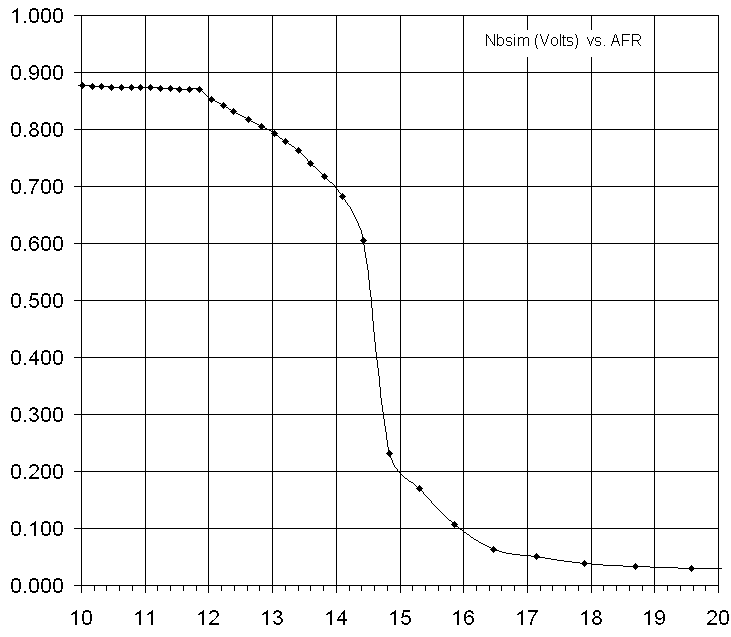
I finally got motivated to get back out there and figure this out. Success!!! I ended up chasing the air - fuel ratio quite a bit with inconsistent results until I realized my gas tank was filthy. I replaced the tank and purged the lines with fresh gas, replaced the filter and injectors, and voila, runs much much better. However, it was still running way too rich, probably because I messed up the setting in the first place. So after getting the fuel system back in good standing, I tried the air - fuel mixture adjustment again. This time I was able to find the right "click" on the AFM that put my O2 sensor between 0.5v and 0.6v. I could even see that one click lean moved the voltage to between 0.4v and 0.5v, and one click rich moved the voltage above 0.6v. According to the chart provided by EMSVITIL I have it set just a bit on the rich side of stoichiometric (14.7:1 equals 0.4 to 0.5 volts). It runs better than it has in years. Takes pedal input without hesitation, and snaps back to idle without stumbling. Thank you for the chart EMSVITIL!!!
In closing, I just want to reiterate that you can tune the AFM using the O2 sensor with the ECU in OPEN LOOP, and the primary benefit of doing this is to give the ECU a good starting point for when it operates in closed loop and to help keep fuel trims close to 0. Of course the ECU will improve on the base fuel map at all RPMs in closed loop, but giving it a good starting point will make the end result that much better. I hope this helps somebody, cheers.
I finally got motivated to get back out there and figure this out. Success!!! I ended up chasing the air - fuel ratio quite a bit with inconsistent results until I realized my gas tank was filthy. I replaced the tank and purged the lines with fresh gas, replaced the filter and injectors, and voila, runs much much better. However, it was still running way too rich, probably because I messed up the setting in the first place. So after getting the fuel system back in good standing, I tried the air - fuel mixture adjustment again. This time I was able to find the right "click" on the AFM that put my O2 sensor between 0.5v and 0.6v. I could even see that one click lean moved the voltage to between 0.4v and 0.5v, and one click rich moved the voltage above 0.6v. According to the chart provided by EMSVITIL I have it set just a bit on the rich side of stoichiometric (14.7:1 equals 0.4 to 0.5 volts). It runs better than it has in years. Takes pedal input without hesitation, and snaps back to idle without stumbling. Thank you for the chart EMSVITIL!!!
In closing, I just want to reiterate that you can tune the AFM using the O2 sensor with the ECU in OPEN LOOP, and the primary benefit of doing this is to give the ECU a good starting point for when it operates in closed loop and to help keep fuel trims close to 0. Of course the ECU will improve on the base fuel map at all RPMs in closed loop, but giving it a good starting point will make the end result that much better. I hope this helps somebody, cheers.



Thread
Thread Starter
Forum
Replies
Last Post
eurojoe
86-95 Trucks & 4Runners
12
Nov 5, 2017 02:39 PM
Beefy_heafy
Staging Area For Tech Article Submissions
0
Sep 19, 2011 12:30 AM


