


A few things I've noticed about the 22R
 Apr 19, 2017 | 06:16 AM
#1

Thread Starter
Registered User
Joined: Dec 2015
Posts: 212
Likes: 39
From: Peralta, NM
A few things I've noticed about the 22R
#1: It sounds a little bit like a diesel to people who aren't used to it. They mistake it for one sometimes, and informing them that it's a gas engine will often make them think something's wrong with it.
#2: Slowly increasing pressure on the gas pedal at the same rate that the engine speed increases will increase gas mileage and the engine will have more power and burn less oil. Try to keep the gas just slightly above a position where you would plateau at the current speed. Everything will be a lot smoother. I'm speaking in terms of Aisin carbs.
#3: The stock Aisin carb is capable of idling much lower and smoother than any other. Because of its small barrels, gas flow into the motor can be much smoother than a larger-barrel carb, because air moving past the jets is going quite a lot faster than it would be in a larger-barrel carb. It gives for a more even fuel flow. It's more restrictive at freeway speeds, but can be more than satisfactory when tuned correctly. But the biggest advantage from good tuning can be had as low-end torque at the lowest speeds.
#4: Oil leaks have a big impact on the performance of the engine. Once all oil leaks have been fixed (and crankcase pressure back to factory specs) a large increase in power will be noticed. That combined with carb tuning can put a later 22R (short-block) almost on comparable levels to the 22R-E.
#5: The Aisin carb is the best at starting up and warming up in the cold, compared against the Weber as it is the only other carb I've had experience with. That is due to its more extensive engineering for cold conditions, and because of the warm air intake flap, which allows warmer air to be taken from the inside of the jacket around the exhaust manifold, which also prevents frosting. The CMH also does it good on cold starts.
#6: The black box behind the left headlight, which most often has a radiator overflow in front of it, is usually perceived as being an intake muffler. Although it does so some (but not much) to muffle the intake, it's a side effect of its actual propose. The device is called a Helmholz Resonator, and it is just an empty box, if anyone was wondering. It has to do with something called "pressure wave harmonics. When a valve closes, air does not patiently wait for the valve to open again, but bounces backwards. When it does so, air flows backward in the intake system, which the engine has to fight against. The Helmholz Resonator is an area where said pressure can expand in, expelling its energy and eliminating the resistance in the intake, so there is none the engine has to fight against (by the perspective of the engine, without the resonator it's fighting against a slight negative pressure) therefore allowing air to flow freely in one direction. This improves power and fuel flow at any speed.
#7: The tube that goes from the carburetor out to behind the grille is a cold air intake. There's no need to replace your cold air intake with a cold air intake if you have an Aisin carb. I see a lot of trucks with the intake tube placed behind the headlight. If you look at the sheet metal behind the grille that the radiator bolts to, you'll find a large diameter hole between the radiator and the radiator overflow. Your intake tube fits snugly through that hole.
#8: The rockers just make that clicking noise. If you can't hear them tapping while the engine is idling, you've probably done your valve adjustments wrong and you're gonna get a valve stuck.
#9: It's OK to have an emissions system. On the 22R they don't weigh that much anyway and the catalytic converter doesn't have much resistance, as well as one can't really remove the majority of the emissions system as none of the other engine components work without them very well. If you want more power at higher speeds, (with the disregard for good low-end torque that usually comes with this desire) then slap a Weber on there and have fun with winter starting. But if one is more interested in low-end power for things like towing or off-road, or really anything else that's truck-related, the emissions system has pretty much no effect. The catalytic converter especially, which people talk so much smack about, does not have a high enough resistance to affect performance at speeds below about 3500 RPM. A much better way (and much cheaper way) to get more power is to restore proper crankcase pressure by fixing oil leaks and replacing things like PCV valves. (and especially the rubber grommet it goes into)
#10: I know I've dissed Weber just a little bit, and I'm sure you all can see my preference for the stock carb. I know sometimes other carbs are fitted on, but I have no experience with them so I cannot say anything about them regarding anything. But down to science; "Bernoulli's principles" are what carbs work off of. His principles state essentially; that air flowing over the end of a tube causes a vacuum on the end of the tube (think jets, that's how gas gets sucked out) and that the amount of vacuum on the tube is directly related to how fast the air is going. It also states that a volume of air will move faster through a smaller area than it will through a larger area when it is exposed to a certain vacuum, meaning that in terms of the carbs, air moves faster through an Aisin than through a Weber, even though the same volume is getting sucked through. This causes the Aisin to be restrictive at high speeds as ultimately there is only so much air that can be sucked through a certain size of carb throat at any given moment. But on the other hand, in the larger barrel carb there is not an ample enough vacuum on the ends of the jets, meaning idle will have to be set to higher for the fuel to flow correctly, and power at low speeds is sacrificed.
#11: You may find yourself having to dial up your motor to 1200 or so to stay running, even though it'll run at much lower speeds when fully warmed up. You may find yourself wishing that there was a high idle that was just for warming up to full heat. Well, you're in luck, because there is a secret high idle. To find it (and the +500 XP) you have to adjust your idle mix screw. On short-blocks, it's turned in all the way and then back 2½ turns. On long-blocks, it's turned in all the way and out 4 turns, then fine tuned from there. It isn't tuned to where it runs highest or lowest, but to where it runs the smoothest. After that is done, idle it down to the lowest possible setting (but not to where it's running rough) then adjust again. Do this until you get it running as low as possible. If you pick up the throttle and it tries to die, or if it tries to die when you snap it back down, adjust the mixture screw more. When it's perfect, you can start it on a warm summer day and it'll idle at around 1k until it warms up, then will fall down to a smooth 750 or so. It won't be like it is in winter, you can drive it around as it's warming up and when you release the gas it'll idle still at 1k or so until it's fully warm. You might say "but Johnsoline, I live at high elevation, my motor's gotta run higher." All I can say to this is that I live at 5,000 feet. It's not the carb that you have to adjust for elevation, it's the ignition timing.
#12: When the engine feels just slightly different, it's low on oil. An experienced 22R person can tell when it's even a quart low.
I'll add more as I think of them.
#2: Slowly increasing pressure on the gas pedal at the same rate that the engine speed increases will increase gas mileage and the engine will have more power and burn less oil. Try to keep the gas just slightly above a position where you would plateau at the current speed. Everything will be a lot smoother. I'm speaking in terms of Aisin carbs.
#3: The stock Aisin carb is capable of idling much lower and smoother than any other. Because of its small barrels, gas flow into the motor can be much smoother than a larger-barrel carb, because air moving past the jets is going quite a lot faster than it would be in a larger-barrel carb. It gives for a more even fuel flow. It's more restrictive at freeway speeds, but can be more than satisfactory when tuned correctly. But the biggest advantage from good tuning can be had as low-end torque at the lowest speeds.
#4: Oil leaks have a big impact on the performance of the engine. Once all oil leaks have been fixed (and crankcase pressure back to factory specs) a large increase in power will be noticed. That combined with carb tuning can put a later 22R (short-block) almost on comparable levels to the 22R-E.
#5: The Aisin carb is the best at starting up and warming up in the cold, compared against the Weber as it is the only other carb I've had experience with. That is due to its more extensive engineering for cold conditions, and because of the warm air intake flap, which allows warmer air to be taken from the inside of the jacket around the exhaust manifold, which also prevents frosting. The CMH also does it good on cold starts.
#6: The black box behind the left headlight, which most often has a radiator overflow in front of it, is usually perceived as being an intake muffler. Although it does so some (but not much) to muffle the intake, it's a side effect of its actual propose. The device is called a Helmholz Resonator, and it is just an empty box, if anyone was wondering. It has to do with something called "pressure wave harmonics. When a valve closes, air does not patiently wait for the valve to open again, but bounces backwards. When it does so, air flows backward in the intake system, which the engine has to fight against. The Helmholz Resonator is an area where said pressure can expand in, expelling its energy and eliminating the resistance in the intake, so there is none the engine has to fight against (by the perspective of the engine, without the resonator it's fighting against a slight negative pressure) therefore allowing air to flow freely in one direction. This improves power and fuel flow at any speed.
#7: The tube that goes from the carburetor out to behind the grille is a cold air intake. There's no need to replace your cold air intake with a cold air intake if you have an Aisin carb. I see a lot of trucks with the intake tube placed behind the headlight. If you look at the sheet metal behind the grille that the radiator bolts to, you'll find a large diameter hole between the radiator and the radiator overflow. Your intake tube fits snugly through that hole.
#8: The rockers just make that clicking noise. If you can't hear them tapping while the engine is idling, you've probably done your valve adjustments wrong and you're gonna get a valve stuck.
#9: It's OK to have an emissions system. On the 22R they don't weigh that much anyway and the catalytic converter doesn't have much resistance, as well as one can't really remove the majority of the emissions system as none of the other engine components work without them very well. If you want more power at higher speeds, (with the disregard for good low-end torque that usually comes with this desire) then slap a Weber on there and have fun with winter starting. But if one is more interested in low-end power for things like towing or off-road, or really anything else that's truck-related, the emissions system has pretty much no effect. The catalytic converter especially, which people talk so much smack about, does not have a high enough resistance to affect performance at speeds below about 3500 RPM. A much better way (and much cheaper way) to get more power is to restore proper crankcase pressure by fixing oil leaks and replacing things like PCV valves. (and especially the rubber grommet it goes into)
#10: I know I've dissed Weber just a little bit, and I'm sure you all can see my preference for the stock carb. I know sometimes other carbs are fitted on, but I have no experience with them so I cannot say anything about them regarding anything. But down to science; "Bernoulli's principles" are what carbs work off of. His principles state essentially; that air flowing over the end of a tube causes a vacuum on the end of the tube (think jets, that's how gas gets sucked out) and that the amount of vacuum on the tube is directly related to how fast the air is going. It also states that a volume of air will move faster through a smaller area than it will through a larger area when it is exposed to a certain vacuum, meaning that in terms of the carbs, air moves faster through an Aisin than through a Weber, even though the same volume is getting sucked through. This causes the Aisin to be restrictive at high speeds as ultimately there is only so much air that can be sucked through a certain size of carb throat at any given moment. But on the other hand, in the larger barrel carb there is not an ample enough vacuum on the ends of the jets, meaning idle will have to be set to higher for the fuel to flow correctly, and power at low speeds is sacrificed.
#11: You may find yourself having to dial up your motor to 1200 or so to stay running, even though it'll run at much lower speeds when fully warmed up. You may find yourself wishing that there was a high idle that was just for warming up to full heat. Well, you're in luck, because there is a secret high idle. To find it (and the +500 XP) you have to adjust your idle mix screw. On short-blocks, it's turned in all the way and then back 2½ turns. On long-blocks, it's turned in all the way and out 4 turns, then fine tuned from there. It isn't tuned to where it runs highest or lowest, but to where it runs the smoothest. After that is done, idle it down to the lowest possible setting (but not to where it's running rough) then adjust again. Do this until you get it running as low as possible. If you pick up the throttle and it tries to die, or if it tries to die when you snap it back down, adjust the mixture screw more. When it's perfect, you can start it on a warm summer day and it'll idle at around 1k until it warms up, then will fall down to a smooth 750 or so. It won't be like it is in winter, you can drive it around as it's warming up and when you release the gas it'll idle still at 1k or so until it's fully warm. You might say "but Johnsoline, I live at high elevation, my motor's gotta run higher." All I can say to this is that I live at 5,000 feet. It's not the carb that you have to adjust for elevation, it's the ignition timing.
#12: When the engine feels just slightly different, it's low on oil. An experienced 22R person can tell when it's even a quart low.
I'll add more as I think of them.
Last edited by Johnsoline; Apr 19, 2017 at 07:23 AM.
Apr 19, 2017 | 06:36 AM
#2
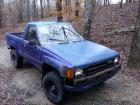
I have never personally seen a 22RE that was faster than a 22R. The RE seems limited and tame. Like you can't just make it go. The 22R however, I feel like you have total control over the throttle. I've had quite a few people notice that my 22R really scoots. And it did this without the header and 32/36. I would say that my truck is just as fast with the header and 32/36 on 31s (6ply) as it was stock as a rock with 235/75/15s. I don't know the math or science behind any of this. Just what I've noticed. Nice post.
Apr 19, 2017 | 07:32 AM
#3
Thread Starter
Registered User
Joined: Dec 2015
Posts: 212
Likes: 39
From: Peralta, NM
At the time of the 80s, the electronic (computer controlled) fuel injection system was new and rudimentary, and carbs were more advanced. That's the reason the Ferrari went back to carbs even though it had had fuel injectors 20 years prior. Even though the 22RE is technically more powerful than the 22R, this power is only more when the engine is driven in the way that the engineers expected. (see: the Japanese drive their cars much differently than Americans) The reason your experience is what it is is because carbs are more forgiving. There's a wide range of ways to use one, whereas computers of the time ran off of strict guidelines and if the driver didn't drive according to said guidelines his performance wouldn't be as good as the factory said. Nowadays computers can calculate based upon which gear you're in, the position of throttle, speed of the car, etc. Back in the day of the 22R-E, they ran simply off of the timing (engine speed) and nothing else. The system was more reliable than carbs, and more reliable than today's fuel injection systems due to less parts. But they didn't have any grace or variability.
Apr 19, 2017 | 12:14 PM
#4
Registered User
iTrader: (1)
Joined: Apr 2009
Posts: 13,381
Likes: 100
From: I live in New Tripoli Pa out in the woods

Not sure why your 22R sounds like a Diesel Mine never did.
Just which Diesel engine
Then maybe your running your valves really loose ??
What do you adjust them to??
Have the valve cover nuts really cranked down
Just which Diesel engine
Then maybe your running your valves really loose ??
What do you adjust them to??
Have the valve cover nuts really cranked down
 Apr 20, 2017 | 12:25 AM
#7
Thread Starter
Registered User
Joined: Dec 2015
Posts: 212
Likes: 39
From: Peralta, NM
I wouldn't say they sound anything at all like a diesel. But I've noticed than people inexperienced with engines will often mistake them for one. I've said the same thing; "what do you mean it sounds like a diesel? It sounds nothing like a diesel." But the whole "isn't your truck a diesel?" Question still persists. Then after that I get "well then why does it sound like that? What's wrong with it?"
I guess if I was not an engine person I might get it confused.
I guess if I was not an engine person I might get it confused.
Last edited by Johnsoline; Apr 20, 2017 at 01:33 PM. Reason: Auto correct


